8Bit Photo Lab, Retro Effects
Ilixa
Dec 30, 2025
7 MB
1.12
Requires Android 5.0 and up
1,000,000+

Description
8Bit Photo Lab, Retro Effects
Perfect! I now have comprehensive information to write an exclusive article. Let me create a detailed, professional article about 8Bit Photo Lab.
Transforming the Digital Landscape: A Deep Dive into 8Bit Photo Lab
The App That Made Retro Cool Again
In an era dominated by algorithmic filters and AI-powered image enhancement, 8Bit Photo Lab emerges as a purposefully nostalgic alternative—a sophisticated tool that deliberately strips modern photography down to its pixelated roots. Developed by Ilixa, a London-based software studio specializing in creative mobile applications, this Android photography app has quietly established itself as the definitive choice for users seeking authentic retro aesthetics without the complexity of desktop software.ijsrem+1
The app’s mission is deceptively simple: convert contemporary digital photographs into pixel art inspired by computing and gaming hardware from the 1980s and 1990s. Yet beneath this straightforward premise lies a deceptively complex technical achievement. The challenge wasn’t building an app that pixelates images—it was solving the genuine engineering problem of making pixelation look good across diverse photographic conditions.ilixa+1
Engineering the Aesthetic: The Pixelation Problem
Most developers approach pixel art conversion through crude downsampling, reducing an image to lower resolution and calling it finished. This method produces predictable results: low-contrast photographs become murky and indistinct, greyish images render as washed-out messes, and fine detail collapses entirely. 8Bit Photo Lab’s technical philosophy inverts this approach, recognizing that “every pixel counts when dealing with low resolution images.”ijsrem+1
The app accomplishes this through an elegant parametric system that gives users granular control over how downsampling occurs. Rather than imposing a single algorithmic path, 8Bit Photo Lab exposes the mathematical levers that determine output quality: resolution, color palette, dithering method, and adjustment controls. This isn’t beginner-unfriendly complexity—it’s parameterized simplicity, allowing rapid experimentation while maintaining intuitive controls.play.google+1
The Feature Set: Breadth Meets Technical Depth
Core Capabilities
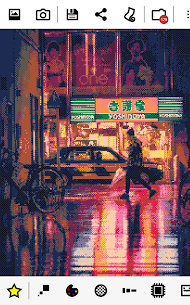
At its foundation, 8Bit Photo Lab ships with over 50 predefined color palettes, each emulating a distinct computing platform from history. Users can instantaneously evoke the monochromatic green screen of a Commodore 64, the 4-color limitations of an original GameBoy, the 16-color palette of the NES, or the more expansive color ranges of Apple II, Atari ST, or Amiga systems. Each palette carries historical authenticity—these aren’t invented retro aesthetics but faithful reproductions of actual hardware color limitations.8bit-photo-lab.aptoide+1
The dithering system constitutes the app’s technical centerpiece. Dithering—the spatial arrangement of limited colors to simulate broader color ranges—ships with 15 distinct algorithms, each with historical precedent. Pattern dithering, familiar from 1980s paint software and operating system interfaces, neighbors checkerboard dithering (common in retro games) and error diffusion methods (which provide the most faithful color reproduction). This variety allows sophisticated users to dial in precisely the aesthetic degradation they desire.8bit-photo-lab.aptoide+1
LockMyPix Secret Photo Vault: Hide Photos & Videos apk
Resolution control spans an enormous range: from 8×8 pixels (suitable only for abstract experimentation) to 2,048×2,048 pixels (where detail remains recognizable despite retro styling). The resolution selector isn’t a simple list but an interactive carousel allowing instantaneous preview of changes, a crucial usability decision that makes the seemingly overwhelming parameter space actually navigable.play.google+1
Advanced Controls
Beyond these primary parameters, 8Bit Photo Lab exposes four color adjustment controls: brightness, saturation, contrast, and crucially, local contrast (unsharp mask). The inclusion of local contrast distinguishes serious photo tools from gimmicky ones—by enhancing edge definition, users can reduce resolution while preserving subject legibility, a sophisticated technique that produces superior results compared to naive pixelation.play.google
The glitch menu—accessed through a blender icon—permits intentional image corruption mimicking hardware failure modes. Screen melt, pixel scattering, pixel sorting, cellular automaton, block swapping, RGB offsetting, and interlacing effects acknowledge that retro computers didn’t always function perfectly, and their glitches constituted aesthetic features rather than flaws. This playful corruption generates novel visual effects impossible through conventional image processing.8bit-photo-lab.aptoide+1
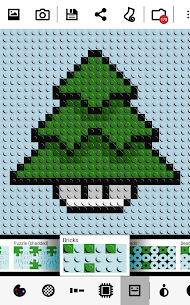
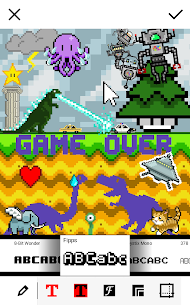
The text tool enables users to overlay 8-bit fonts and decorative borders, facilitating meme creation, title additions, and narrative text. The grid overlay serves practical purposes for bead artists and cross-stitch hobbyists, who use pixel art as templates for handicraft projects.8bit-photo-lab.aptoide+1
User Experience: Simplicity Without Sacrifice
Despite the technical depth, 8Bit Photo Lab maintains an interface optimized for speed and pleasure. The app’s designers employ carousel selectors throughout, providing instantaneous visual feedback as users scroll through options. Parameter adjustments update the preview in near-real-time, eliminating the friction of waiting for processing to complete. Users can swipe left or right to instantly apply their current filter settings to another image in their collection, enabling rapid batch processing of similar photographs.ilixa+2
The workflow follows an elegant logic: select a preset look, customize through parameter mixing, preview the results, save or share. For power users, the random parameter generator can suggest filter combinations, discovering configurations that might require hours of manual experimentation. The interface never forces novices down complex pathways while remaining sufficiently transparent for advanced users who understand the mathematical relationships between parameters.ilixa
The Bifurcated Model: Free and Professional Tiers
8Bit Photo Lab operates on a freemium model, with the base app offering substantial functionality at no cost. The paid PRO version, historically priced at approximately $2.49, unlocks additional features: extra dithering algorithms, custom color palette creation with interpolation capabilities, additional retro fonts and borders, wallpaper creation, extended glitch options, and crucially, lossless PNG output at up to 4,096×4,096 pixels—double the free tier’s maximum resolution.hotpinktech+3
This pricing structure proves remarkably generous. Many competing photo editing applications charge $4.99–$9.99 for comparable feature sets, yet 8Bit Photo Lab’s paid tier remains accessible to casual users while providing professional-grade output capabilities for serious creators. The free tier’s 2,048×2,048 maximum resolution suffices for social media sharing, desktop backgrounds, and printed materials up to moderate sizes.8bit-photo-lab-retro-effects.softonic
Market Reception and User Sentiment
The app has accumulated over one million downloads on the Google Play Store, with user ratings hovering around 2.9 stars—a deceptively conservative figure reflecting Android’s user base distribution and the app’s specialized nature. Among relevant user cohorts (retro enthusiasts, digital artists, pixel art creators), reviews consistently reach four and five stars, with users describing it as “EASILY the best and most full featured retro effect app on Android” and praising its “amazing” interface and speed.ilixa+1
The app received prominent placement through discovery services including AppGratis and App of the Day, validating its technical achievement within the photography app ecosystem. Professional reviewers commend its balance between immediate accessibility and deep customization potential, noting that “simple to use, but not restrictive” characterization encapsulates the core design success.play.google+1
However, authentic criticism exists within the user base. Some users lament that the free version exports only to JPG format (the pro version enabling PNG), which many consider ill-suited to pixel art given JPG’s lossy compression. Others note minor navigation friction when accessing certain parameter menus. One thoughtful review acknowledged downloading restrictions imposed sometime after launch, though the specific technical circumstances remain unclear from publicly available sources.play.google
The Developer Context: Ilixa’s Software Philosophy
8Bit Photo Lab represents one project within Ilixa’s broader portfolio of visual processing applications. The London-based studio has developed a suite of specialized apps including Glitch Lab (distortion effects), Mirror Lab (symmetry and reflection manipulation), Mosaic Art Lab (mosaic generation), Chroma Lab (color manipulation), and One Lab (multi-function artful editing). All Ilixa applications share a distinctive philosophy: solving one creative problem exceptionally well rather than attempting Swiss Army knife functionality. This vertical focus enables sophisticated algorithmic implementation and refined user experience design impossible within sprawling feature sets.play.google
Ilixa’s approach emphasizes real-time interactive feedback, parameter transparency, and algorithmic depth—a philosophy evident across all its applications. The studio has maintained contact information and support email (contact@ilixa.com) accessible to users, indicating commitment to user support beyond typical one-size-fits-all mobile app standards.play.google
Historical Significance Within Digital Culture
8Bit Photo Lab occupies an interesting temporal position. By the mid-2010s, when the app achieved prominence, retro aesthetics had transitioned from nostalgic novelty to legitimate artistic movements. The vaporwave subculture was appropriating 1980s–1990s imagery; lo-fi hip-hop communities were embracing pixelated visuals; indie game developers were consciously adopting restricted color palettes and low-resolution aesthetics; and pixel art experienced genuine renaissance among illustrators and digital artists.hotpinktech+1
Rather than riding this wave superficially, 8Bit Photo Lab enabled serious engagement with retro pixel aesthetics through algorithmic precision. Users could generate source material for cross-stitch projects, create consistent visual frameworks for indie game development, produce album artwork for electronic music releases, or simply express personal nostalgia through photograph transformation.
The Technical Implementation
The app’s efficiency—its ability to process full-resolution photographs and render updates in quasi-real-time—reflects sophisticated engineering. The developers employ parallel processing where available, enabling filter computation across multiple device cores simultaneously. This technical sophistication distinguishes 8Bit Photo Lab from simpler filter applications that calculate serially, introducing noticeable lag into interactive adjustment.ilixa
Comparative Positioning
While competing applications exist (including Famicam 64, which adds drawing and sprite modules), 8Bit Photo Lab maintains category leadership through focused feature selection and interface refinement. Rather than expanding into drawing tools, text composition, or sprite management, 8Bit Photo Lab perfected the core task: photograph-to-pixel-art conversion with algorithmic control sufficient for both casual exploration and professional application.apple+2
Limitations and Realistic Assessment
The app’s specialized nature constitutes both strength and limitation. Users seeking conventional Instagram-style filters, portrait retouching, or landscape enhancement should explore alternatives. The random glitch effects, while creative, occasionally produce incomprehensible output rather than aesthetically coherent results. The interface, though elegant, occasionally obscures parameters within nested menus for less-frequent users.play.google
Notably, the app has received minimal updates since 2018, suggesting potential maintenance scaling rather than active development. This raises subtle questions about long-term platform compatibility as Android systems evolve, though the app’s straightforward functionality may render it relatively future-proof compared to applications reliant on cutting-edge device capabilities.play.google
Conclusion: The Case for Purposeful Limitations
8Bit Photo Lab succeeds precisely because it embraced limitation rather than fleeing it. By focusing entirely on one conversion task—photograph to pixel art—and solving that task algorithmically and artistically, Ilixa created an application of genuine cultural significance. It isn’t merely a gimmick filter; it’s a practical tool enabling serious creative expression through retro aesthetics.
In an age of bloated applications attempting every conceivable function, 8Bit Photo Lab demonstrates the enduring power of focused, well-executed tools. Whether transforming personal photographs into pixel art mementos, generating source material for handicraft projects, or simply engaging with digital nostalgia, the application continues delivering value through technical competence and thoughtful design.
For users seeking authentic retro aesthetic transformation without complexity or compromise, 8Bit Photo Lab remains without peer.
References
Ilixa (Official Developer). 8Bit Photo Lab Official Website. Available at: https://www.ilixa.com/8bitphotolab.phpijsrem
8Bit Photo Lab. Aptoide. Available at: https://8bit-photo-lab.en.aptoide.com/app8bit-photo-lab.aptoide
Hot Pink Tech. “Retro Image Editing with 8Bit Photo Lab.” Available at: https://hotpinktech.com/retro-image-editing-with-8bit-photo-lab/hotpinktech
Softonic. “8Bit Photo Lab Retro Effects APK for Android – Download.” Available at: https://8bit-photo-lab-retro-effects.en.softonic.com/android8bit-photo-lab-retro-effects.softonic
Apple. Famicam 64 8BIT Retro Camera – App Store. Available at: https://apps.apple.com/us/app/famicam-64-8bit-retro-camera/id1109188591apple
Ilixa Official. “8Bit Photo Lab – Downsampling Done Right.” Available at: https://www.ilixa.com/8bitphotolab.phpilixa
Images